Romania’s First IVF Birth in a Case of Total Globozoospermia
The first IVF baby born in Romania in a case of total globozoospermia


At Gynera, for nearly 20 years, we have integrated the male factor from the very beginning into the complete fertility diagnosis of the couple. We know that male fertility means far more than a standard semen analysis and that factors such as sperm DNA integrity, medical history, or embryo quality can directly influence the chances of achieving pregnancy.
Traditionally, infertility has been viewed almost exclusively through the perspective of female fertility. Today, data shows that a male factor is involved in nearly half of infertility cases. Yet many men are still investigated too late or incompletely.
At Gynera, male fertility evaluation receives the same level of attention, the same complexity of investigations, and the same personalized approach as female fertility evaluation.
That is why we created Gynera For BOTH of Us — a program specifically developed for couples, where both partners are evaluated in an integrated way by a multidisciplinary team consisting of an IVF specialist, urologist/andrologist, geneticist, and embryologist, complemented, whenever needed, by personalized lifestyle recommendations and coaching.
Through the Gynera For BOTH of Us program, we further advance this philosophy by integrating AI IVF Clarity — an artificial intelligence-based tool that helps estimate ovarian stimulation response, probability of success, and define an optimal, personalized IVF strategy for each couple.
have been trying to conceive for over a year without success
Because male fertility evaluation is not limited to a simple semen analysis. It also means evaluating sperm genetic quality, sperm DNA integrity, the impact of lifestyle, and how all these factors influence embryo development and real pregnancy chances.
'%3e%3cpath%20opacity='0.5'%20fill-rule='evenodd'%20clip-rule='evenodd'%20d='M530.971%201991.58C169.705%201246.56%20264.669%20578.468%20888.268%2028.8621C892.751%2024.9101%20896.776%2020.9101%20900.512%2017.1984C918.133%20-0.31075%20929.298%20-11.4051%20951.478%2019.2075C1021.22%20115.451%20999.613%20331.138%20947.508%20405.747C398.674%20574.879%20378.425%201344.22%20537.403%201937.55L530.971%201991.58ZM22.3954%20408.932C277.493%20487.584%20286.939%20845.21%20213.028%201121.05L216.042%201146.17C383.964%20799.869%20339.798%20489.253%2049.9301%20233.784C47.8591%20231.947%2045.9978%20230.089%2044.2702%20228.366L44.2696%20228.365L44.2693%20228.365C36.0634%20220.177%2030.8713%20214.996%2020.5364%20229.235C-11.8721%20273.969%20-1.82298%20374.256%2022.3954%20408.932ZM293.321%20268.732C309.529%20261.057%20328.193%20258.241%20347.13%20261.788C395.165%20270.735%20426.92%20317.239%20417.976%20365.562C409.033%20413.937%20362.807%20445.832%20314.772%20436.885C266.737%20427.938%20234.981%20381.434%20243.925%20333.06C245.209%20326.084%20247.272%20319.449%20250.007%20313.229C248.231%20317.033%20246.696%20320.986%20245.423%20325.07C242.66%20313.848%20241.152%20302.172%20241.202%20290.04C241.604%20211.034%20305.567%20147.041%20384.151%20147.445H384.252C462.786%20147.799%20526.397%20212.146%20525.995%20291.203C525.593%20369.35%20463.087%20432.787%20385.759%20433.798C409.224%20418.937%20425.956%20393.916%20429.272%20364.042C435.05%20312.18%20397.668%20265.272%20346.015%20259.408C327.225%20257.283%20309.084%20260.837%20293.321%20268.732Z'%20fill='%23123571'/%3e%3c/g%3e%3cdefs%3e%3cclipPath%20id='clip0_5585_182120'%3e%3crect%20width='996'%20height='1992'%20fill='white'/%3e%3c/clipPath%3e%3c/defs%3e%3c/svg%3e)
The first IVF baby born in Romania in a case of total globozoospermia
The highest number of IVF babies in Romania* (*disclaimer: during 2007–2025)
In 2025, 2 out of 3 patients under the age of 40 achieved a positive pregnancy test following IVF procedures at Gynera (67%)*(*Disclaimer: the rate refers to positive BHCG tests per procedure in patients ≤40 years old during 2025.)
At Gynera, we use advanced sperm diagnostic and selection technologies, AI-assisted embryology, and personalized protocols for every couple. From specialized urology consultations and Male Infertility Board reviews, to MACS, ZYMOT, ICSI/PICSI, EmbryoScope®, and iDAScore, every step is designed for greater precision and evidence-based medical decisions.
These are subtle aspects that cannot always be identified in a single test result, yet they can make a significant difference in your journey toward pregnancy.
That is why, at Gynera, we view male fertility as an essential part of a complex ecosystem: the couple.
A complete evaluation comes from correlating all information within the context of your real story.
a state-of-the-art embryology laboratory built to international standards
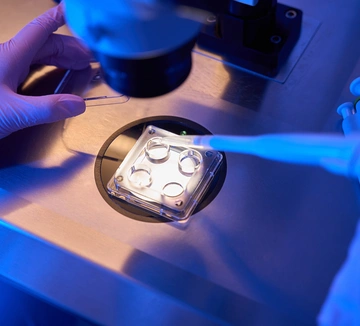
nearly 20 years of dedicated expertise in male infertility

integration of reproductive genetics into the complete fertility evaluation

a multidisciplinary approach involving IVF specialists, andrology-trained urologists, embryologists/andrologists
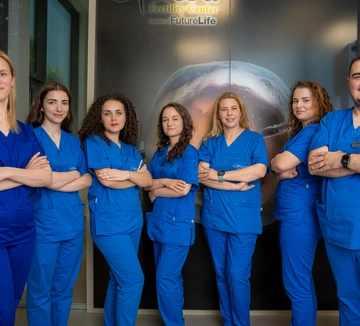
personalized protocols tailored to each couple, not standard approaches

advanced sperm selection technologies (MACS, ZYMOT), supporting better-informed medical decisions
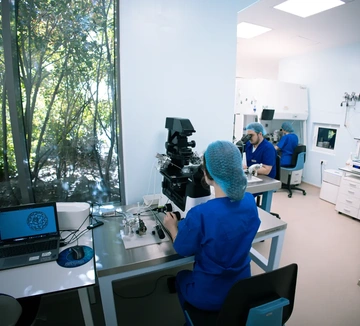
AI IVF Clarity, an artificial intelligence-based tool that helps estimate ovarian stimulation response, probability of success, and define an optimal IVF strategy

Because here, fertility evaluation means programs specifically designed for both partners.
Beyond our extensive expertise in couple infertility, at Gynera you benefit from:
At Gynera, every case is evaluated in an integrated way by a multidisciplinary team working together toward the same goal: helping you fulfill your dream of becoming parents.
The IVF specialist builds the overall picture. They integrate both partners’ results and define a treatment strategy adapted to your medical history and reproductive goals.
Investigates the male fertility component in depth, identifying treatable causes ranging from varicocele and infections to hormonal imbalances or factors affecting sperm quality. He is the specialist dedicated to male reproductive health.
Looks beyond numbers and standard parameters. Evaluates the real reproductive potential of sperm cells and selects the most appropriate sperm selection methods using advanced technologies that may directly influence the final outcome.
Completes the evaluation by identifying genetic causes that may affect fertility, embryo quality, or pregnancy evolution. From sperm DNA fragmentation and chromosomal abnormalities to genetic conditions that may remain “invisible” in standard investigations, the geneticist contributes to establishing a more precise diagnosis.

Male fertility, an essential factor, is often overlooked. Many men only evaluate their fertility after difficulties in achieving pregnancy appear.
The reality is:
The good news: in many cases, male fertility can be improved or treated, especially when evaluation is accurate and performed at the right time.
when pregnancy is delayed
when there is a history of infertility in the couple
after IVF failures
when you want to understand your fertility early
when risk factors are present (smoking, stress, unhealthy lifestyle, poor diet, etc.)
Fertility is not only about “if”, but also about when and how.
Magnetic-Activated Cell Sorting (MACS) is an advanced technology used in the IVF laboratory to select healthy sperm cells with intact DNA.
The result is a biologically more precise selection compared to standard methods.
MACS may make a difference in cases such as:
A technology designed to optimize not only the procedure, but the final outcome.
Essential information for understanding why pregnancy is delayed.
After interpreting the investigation results, every case is approached individually through a unique program specifically designed by the Gynera team.
Because every couple is different, and fertility has no standard solutions.
Depending on the results, the physician may recommend:
The goal is clear: maximizing the chances of achieving a healthy pregnancy.

At Gynera, for over 20 years, we have evaluated and treated male infertility with the help of urologists specialized in andrology and male reproductive medicine, integrating the male factor from the very beginning into the couple’s complete fertility diagnosis. We know that male fertility means more than a semen analysis and that factors such as sperm DNA integrity, medical history, or embryo quality may directly influence pregnancy chances.
Today, through the Gynera For BOTH of Us program, we further advance this approach by integrating AI IVF Clarity — an artificial intelligence-based tool that helps estimate ovarian stimulation response, probability of success, and define an optimal and personalized IVF strategy for every couple.
A semen analysis is a basic test used to evaluate sperm quality by assessing parameters such as sperm count, motility (movement), and morphology (shape). In most cases, it is the first step in evaluating male fertility.
Not always.
A semen analysis provides important information, but it does not capture all aspects of male fertility. Issues such as sperm DNA fragmentation, oxidative stress, or genetic abnormalities may exist even when standard semen parameters appear normal
Male infertility is involved in approximately 40–50% of infertility cases, either as the main factor or alongside a female factor. Despite this, it is often underdiagnosed or investigated too late.
Sperm DNA fragmentation is an indicator of the genetic quality of sperm cells. High levels are associated with lower fertilization rates, poorer embryo quality, and an increased risk of miscarriage, even when the semen analysis appears normal.
MACS (Magnetic Activated Cell Sorting) is an advanced sperm selection technology used in IVF procedures that allows the isolation of viable sperm cells with intact DNA, reducing the risk of using sperm with genetic damage.
Yes, in many cases.
Depending on the cause, male fertility may be improved or treated through:
Male fertility testing is recommended:
No.
Infertility is not related to sexual function. A man may have normal erections and ejaculation, but poor sperm quality.
Yes, significantly.
Smoking, alcohol consumption, chronic stress, poor diet, and sedentary lifestyle can affect sperm quality and DNA integrity, influencing not only fertility but also the future child’s health.
Yes.
After the age of 40, the risk of sperm DNA fragmentation, genetic abnormalities, and miscarriage increases, even if semen analysis parameters appear normal.
ICSI may facilitate fertilization, but it does not repair damaged sperm DNA. That is why it is essential for the male factor to be properly investigated and treated, not simply bypassed through laboratory techniques.
TESE (testicular sperm extraction) is a modern procedure that allows sperm retrieval directly from the testicle. It is useful in severe cases, including situations where sperm cells are absent from the ejaculate.
Yes. Some of the most important fertility issues involve sperm DNA integrity, genetic factors, or sperm functionality, which cannot be identified through standard tests and require advanced investigations.
Now you can also book online consultations!