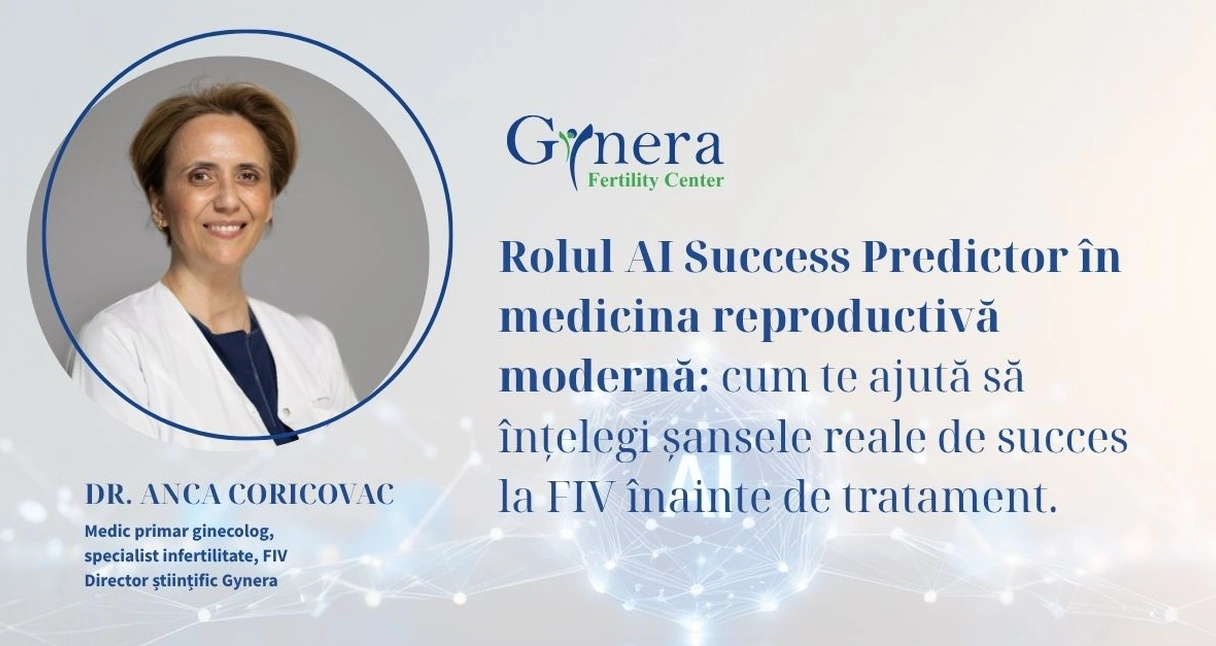
Every couple starting IVF asks the same question: "What are our real chances of success?" Until recently, physicians could only rely on general statistics. Today, artificial intelligence is transforming reproductive medicine. Available exclusively at Gynera, AI Success Predictor analyzes each couple's reproductive profile to generate a personalized estimate of IVF success before treatment begins, helping physicians and patients make more informed decisions and develop a treatment strategy tailored to their individual circumstances.
A personalized report generated with the help of artificial intelligence is now included in Gynera's infertility consultation package. Not to provide definitive answers — but to ensure you begin treatment with a clearer understanding of your individual chances of success.
One of the hardest questions I hear in my office never comes at the beginning of the consultation. It comes after we've discussed the procedure, reviewed the stimulation protocol, and explained every technical step. Just when the consultation seems to be ending, someone quietly asks: "What are my chances?"
It is probably the most natural question any patient can ask — and, at the same time, the one no fertility specialist can answer with absolute certainty. Until recently, all we could offer was a general statistical estimate: the average success rate for women of a similar age and diagnosis. A truthful answer — but not your answer.
Because you are not an average. You have your own ovarian reserve (AMH), your own reproductive history, your own diagnosis, and a unique biological profile. This is precisely the shift we have introduced at Gynera: moving from population-based statistics to an individualized prediction built around your reproductive profile.
Your chances are not the same as the average chances of people who merely resemble you. Today, we can make that distinction.
What Is AI Success Predictor?
AI Success Predictor is an artificial intelligence–based clinical decision support tool that analyzes your reproductive profile and estimates your likelihood of IVF success before treatment begins. Rather than providing generic statistics, it delivers a personalized assessment that helps you and your medical team design the treatment strategy best suited to your individual situation.
What AI Success Predictor Is Not
AI Success Predictor is not a crystal ball, nor does it guarantee treatment success. It generates an estimate based on validated clinical data but cannot predict biological events that occur later in the treatment journey, such as embryo quality, individual endometrial receptivity, or other biological mechanisms that current medical science cannot yet fully quantify. For this reason, the AI report complements the physician's expertise — it never replaces it.
What Does a Probability Percentage Actually Mean?
One of the most common misunderstandings in reproductive medicine concerns the interpretation of probabilities. A probability does not tell you what will happen. It tells you what happened in patients with a reproductive profile similar to yours.
- 70% — A 70% estimate means that, among patients with comparable medical characteristics, approximately 70 out of 100 achieved a live birth. It is not a guarantee of your individual outcome. Instead, it provides an objective reference point that helps your physician determine the most appropriate treatment strategy for your specific case.
- 35% — A lower probability does not mean treatment is unlikely to succeed. Rather, it indicates that your treatment strategy may benefit from further optimization before IVF begins. This may include adjusting the ovarian stimulation protocol, recommending additional investigations, or considering complementary technologies or genetic testing.
Having this information before treatment — not after an unsuccessful embryo transfer — allows both physician and patient to make better-informed decisions from the very beginning.
A Helpful Analogy
If a weather forecast predicts an 80% chance of rain tomorrow, it may still remain sunny. Likewise, a 20% chance does not mean rain is impossible. Probability reflects patterns observed across thousands of similar cases — not an individual's predetermined future. AI Success Predictor works according to the same principle.
The Five Variables That Shape Your Prediction
Why these five variables? Each reflects a different aspect of your current reproductive health. None can replace another, and AI Success Predictor evaluates them together, understanding how they interact rather than considering them in isolation.
- Age at Egg Retrieval — Female age remains one of the strongest predictors of IVF success because egg quality naturally declines over time, particularly after the age of 35. AI Success Predictor evaluates age year by year — not by decades — recognizing that the difference between a 36-year-old and a 39-year-old patient can significantly influence the estimated outcome.
- AMH (Anti-Müllerian Hormone) — AMH reflects ovarian reserve, the number of follicles potentially available for stimulation. Two women of different ages may have completely different reproductive profiles depending on their AMH values, making this one of the most important variables included in the analysis.
- Body Mass Index (BMI) — Body weight influences both ovarian response to hormonal stimulation and endometrial receptivity. It is a clinically validated biological factor that contributes to treatment success and is therefore incorporated into the predictive model.
- Previous Live Birth — A previous successful pregnancy provides valuable clinical information. Historical data consistently show that women who have previously delivered a baby generally have a more favorable reproductive prognosis than those who have never achieved a live birth.
- Cause of Infertility — Perhaps the most influential variable is the underlying cause of infertility. A couple facing isolated male-factor infertility follows a very different reproductive pathway compared with cases involving severe endometriosis, bilateral tubal disease, diminished ovarian reserve, or unexplained infertility. This is why identifying the correct diagnosis remains essential before beginning treatment.
Your AI Report: More Than a Single Number
One of the greatest advantages of AI Success Predictor is that it does not provide just one probability. Instead, it estimates how your cumulative chances of achieving a live birth evolve over one, two, or three IVF cycles. This reflects real-world clinical practice. IVF is rarely a single event. Many couples require more than one stimulation cycle, and understanding this possibility before treatment begins can profoundly influence expectations, planning, and decision-making.
Your personalized report presents:
- Estimated live birth probability after the first IVF cycle
- Cumulative probability after two IVF cycles
- Cumulative probability after three IVF cycles
Rather than focusing on a single percentage, the report helps patients understand the broader treatment journey. Illustrative values shown in the report are examples and do not represent individual patient results.
What Does This Mean in Clinical Practice?
The AI report is the starting point of a conversation — not its conclusion. Beyond providing an overall probability, the report highlights which variables have the greatest influence on your individual prediction. For one patient, ovarian reserve may be the determining factor. For another, age or infertility diagnosis may have a greater impact. These findings are always interpreted together with your physician because numbers without clinical context can be misleading.
When the Prediction Is Favorable
A positive estimate allows treatment to begin with greater confidence — not blind optimism, but confidence supported by your own medical data.
When the Prediction Is Lower Than Expected
A lower prediction should never be interpreted as a verdict. Instead, it provides valuable clinical guidance before treatment even starts. Based on your personalized report, your medical team may recommend:
- Optimizing the ovarian stimulation protocol
- Performing additional investigations
- Considering preimplantation genetic testing (PGT)
- Incorporating complementary laboratory technologies
Knowing this before treatment, rather than after an unsuccessful cycle, creates opportunities to optimize your strategy from the outset.
Understanding the Limits of Artificial Intelligence
Like every medical tool, AI Success Predictor has limitations. It cannot predict embryo quality before fertilization. It cannot anticipate individual endometrial responses or biological mechanisms that remain beyond current scientific understanding. Its role is not to replace clinical judgment but to strengthen it by providing physicians with a far more individualized estimate than traditional statistical averages ever could.
What Makes This Approach Different?
Until now, IVF consultations inevitably began with generalized success rates. Today, they begin with your own reproductive profile. This does not change biology. It changes the quality of the discussion that takes place before treatment even starts. Instead of relying on population averages, physicians and patients can build a treatment strategy based on individualized medical evidence.
"One of the most valuable things a fertility specialist can offer before IVF is not simply hope — it is accurate information. AI Success Predictor does not tell us what will happen. It tells us what current scientific evidence suggests for patients with similar reproductive profiles. That is where meaningful clinical decision-making begins."
Included in the Gynera For Both of Us Program
The AI Success Predictor Report is included in the Gynera For Both of Us consultation package. Through this unique program, Gynera goes beyond conventional fertility assessment by integrating AI Success Predictor, an advanced artificial intelligence–based clinical decision support tool that helps estimate ovarian response, IVF success probability, and the most appropriate treatment strategy for each couple.
Gynera is currently the only IVF clinic in Romania to offer this technology, providing patients with a clearer, more realistic, and highly personalized understanding of their chances of success before beginning treatment.

Dr. Anca Coricovac, MD, PhD
Senior Consultant Obstetrician & Gynecologist, Specialist in IVF and Assisted Human ReproductionMale infertility
A condition in which male reproductive factors contribute to difficulties in achieving a pregnancy. Causes may include hormonal, genetic, anatomical, lifestyle or sperm-related factors.
Semen analysis (spermogram)
A laboratory examination used to assess male fertility by evaluating sperm concentration, motility and morphology, as well as semen volume.
Sperm DNA fragmentation (SDF)
Damage or breaks in the genetic material carried by sperm cells. Increased sperm DNA fragmentation may be associated with reduced fertility, impaired embryo development and a higher risk of reproductive failure.
Sperm DNA fragmentation test
A specialized laboratory test used to evaluate sperm DNA integrity. Common testing methods include TUNEL, SCSA, Comet assay and SCD.
Spermatogenesis
The biological process through which sperm cells are produced and mature in the testes. Abnormalities during spermatogenesis may affect sperm quality and DNA integrity.
Oxidative stress
An imbalance between reactive oxygen species and the body's antioxidant defenses. Excessive oxidative stress can damage sperm membranes and sperm DNA.
Varicocele
An enlargement of veins around the testicle that may increase testicular temperature and oxidative stress and, in some men, negatively affect sperm quality and fertility.
Azoospermia
The absence of sperm in the ejaculate. It is a severe form of male infertility that may require additional hormonal, genetic or urological evaluation.
ICSI (Intracytoplasmic Sperm Injection)
An assisted reproduction technique in which a single sperm cell is injected directly into an egg to achieve fertilization.
IVF (In Vitro Fertilization)
An assisted reproductive treatment in which eggs are fertilized with sperm in a laboratory before an embryo is transferred to the uterus.