In IVF, sperm selection can become particularly important in cases involving high sperm DNA fragmentation, significant male-factor infertility, or repeated IVF/ICSI failure. MACS (Magnetic-Activated Cell Sorting) is an advanced sperm-selection method used before ICSI that can help the laboratory work with a more favorable sperm fraction. Learn how MACS works, when it may be recommended, what semen analysis and microscopic assessment cannot reveal, and how this technique differs from ZyMōt and PICSI.
When a semen analysis appears normal but sperm DNA fragmentation is present, or when embryos stop developing, MACS may provide an additional selection step before a sperm cell is chosen for ICSI.
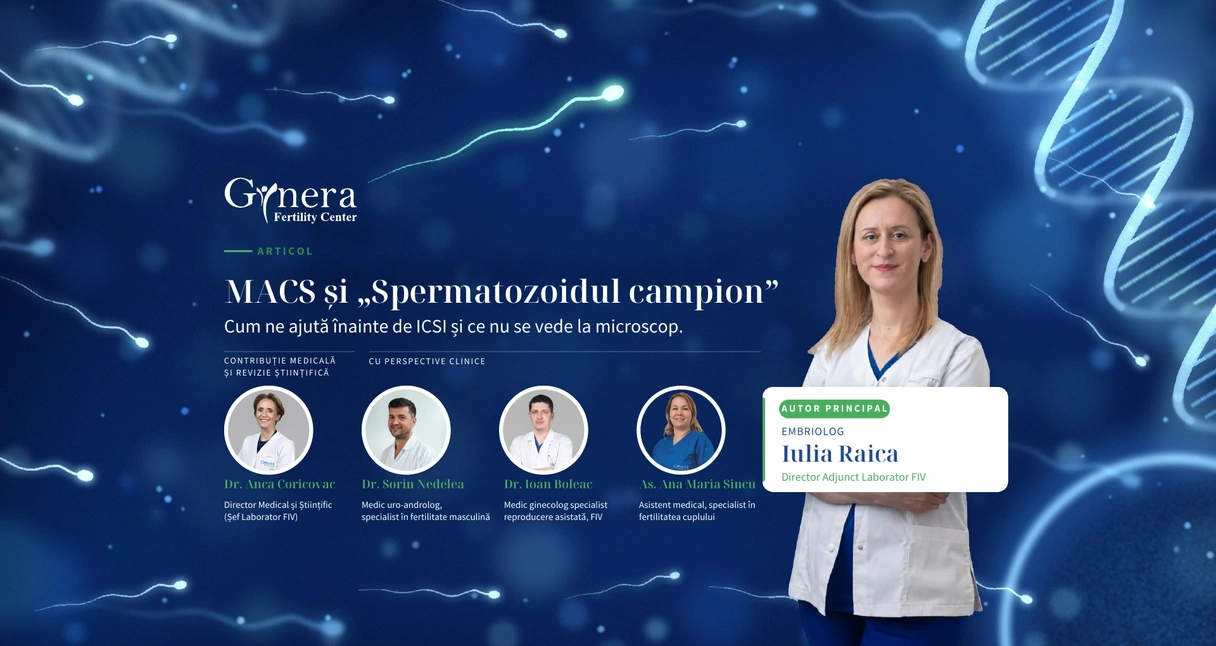
Lead author:
Embryologist Iulia Raica — Deputy Director, IVF Laboratory
Medical contribution and scientific review:
Dr. Anca Coricovac — Medical and Scientific Director (Head of IVF Laboratory)
With clinical perspectives from:
Dr. Sorin Nedelea — Urologist-Andrologist, Male Fertility Specialist; Dr. Ioan Boleac — Gynecologist, Assisted Reproduction and IVF Specialist; Ana Maria Sincu — Nurse, Couple Fertility Specialist
It looks good. It moves well. But DNA cannot be seen under the microscope.
This is why, in some cases, before ICSI, we need an additional filter: MACS.
In ICSI, the embryologist selects a single sperm cell for each oocyte. The embryologist assesses its shape, observes how it moves and selects it from among a very large number of cells. It is a careful decision based on experience. However, the microscope only shows us what can be observed externally. It cannot directly tell us how well the DNA inside the sperm cell has been preserved.
“Here lies the limitation of conventional selection,” explains Iulia Raica, Deputy Director of the IVF Laboratory. “We can choose a sperm cell that looks good and moves well, but we cannot see its DNA. If there is increased DNA fragmentation or a medical history that raises concerns regarding the male factor, MACS can help us select the sample more carefully before ICSI.”
MACS, explained for patients
MACS is, simply put, an additional filtering step applied to the sperm sample before ICSI.
The sample passes through a magnetic separation system that helps retain sperm cells displaying signs of cellular degradation. From the cells that pass through, the embryologist makes the final selection from a more favorable fraction.
Iulia Raica explains: “We are not looking for a perfect sperm cell. We are trying to start with a better-selected sample and, from that sample, choose the sperm cell used for ICSI as accurately as possible.”
Importantly, MACS also has limitations: it does not genetically test each sperm cell and cannot guarantee that the selected sperm has perfect DNA. It is an additional selection step, not a certainty.
Why can it matter even when the semen analysis is good?
Semen analysis remains the fundamental test. It tells us how many sperm cells are present, how they move and what they look like. However, this information does not directly describe the integrity of sperm DNA.
This is why situations may occur in which the semen analysis is reasonably good and fertilization takes place, yet embryo development does not progress as expected. This does not automatically mean that the sperm is responsible.
It means that, in some situations, the male factor deserves closer evaluation alongside all the other information available from that particular treatment cycle.
“In the laboratory, we never look at a result in isolation,” says Iulia Raica. “We assess fertilization, how the embryos divide, how many reach the blastocyst stage and what happened during previous cycles. Only then can we determine whether an additional selection method such as MACS makes sense.”
When embryos stop developing
When oocytes have been retrieved and fertilization has occurred, but some embryos subsequently stop developing before reaching the blastocyst stage, the result can be difficult for patients to receive. From a medical perspective, however, it also provides valuable information for the next step.
Embryo arrest does not mean that “something was done wrong,” nor does it automatically point to a single cause. Development depends on the oocyte, the sperm cell and numerous biological processes working together during the first days after fertilization.
Dr. Ioan Boleac, IVF gynecologist, explains: “A cycle in which embryos stop developing must be analyzed as a whole. We look at age, ovarian response, oocyte quality, fertilization, embryo development and the male factor. If the same pattern repeats, we can adjust both the investigations and the strategy for the next procedure.”
MACS may be one of the options discussed when there are reasons to examine the male factor more closely. Not because it can address every possible cause of embryo arrest, but because it allows us to optimize one of the stages we can influence: sperm selection.
When can MACS be considered?
MACS is not a procedure required in every IVF cycle. It may be considered when there is a specific reason for more refined sperm selection:
- increased sperm DNA fragmentation
- significant male-factor infertility or unfavorable sperm parameters
- repeated IVF/ICSI failures, following analysis of previous cycles
- certain cases of unexplained infertility in which the sperm factor remains a possible explanation
“For me, the key is the indication,” says Iulia Raica. “MACS is not added simply because it is a modern technology. We use it when the patient’s history and the laboratory data suggest that it may provide something useful in sperm selection for ICSI.”
What do the studies show?
The studies included in the bibliography of this article indicate that MACS may reduce the proportion of sperm cells displaying signs of cellular degradation and may improve the quality of the selected sperm fraction.
In certain groups of patients, particularly those with increased sperm DNA fragmentation, favorable pregnancy outcomes and, in some studies, improved live birth outcomes have been reported.
However, results are not identical across all studies or all patient populations. MACS should therefore be regarded as a useful tool for appropriately selected cases, rather than a guarantee of success.
Iulia Raica summarizes it simply: “MACS can help us start with a better-selected sperm fraction. What happens subsequently with the embryo depends on many factors. Embryo development depends on the oocyte, the sperm cell and the many biological processes that begin working together.”
MACS, ZyMōt and PICSI are not the same
All three are techniques that can help the laboratory refine sperm selection, but they work in different ways.
MACS aims to remove some sperm cells displaying signs of cellular degradation. ZyMōt selects sperm cells capable of moving efficiently through microchannels. PICSI selects sperm cells based on a characteristic associated with functional maturity.
“There is no single technique that is better for everyone,” explains Iulia Raica. “We choose the method based on what we see in each individual case. Sometimes standard sperm preparation is sufficient. In other situations, an additional selection step may make sense.”
Frequently asked questions: our team answers
Can the semen analysis be normal even when sperm DNA fragmentation is present?
Dr. Sorin Nedelea — Urologist-Andrologist, Male Fertility Specialist
Yes. Semen analysis primarily tells us about sperm concentration, motility and morphology. DNA integrity is a different type of information.
In certain situations, particularly when risk factors, reproductive loss or IVF results raise questions regarding the male factor, additional evaluation may be useful.
What does the embryologist see when selecting a sperm cell for ICSI?
Iulia Raica — Deputy Director, IVF Laboratory
I can see how the sperm cell moves, what it looks like and how it behaves at the moment of selection. I cannot directly see its DNA.
This is precisely where MACS may help: before the final selection, it allows us to work with a more carefully selected sperm fraction.
If embryos stopped developing, does that mean the problem came from the sperm?
Dr. Ioan Boleac — IVF Gynecologist
No. Embryo developmental arrest can have multiple causes.
We analyze the entire cycle and try to determine whether there is a recurring pattern. If male-factor elements are also identified, sperm selection may become one of the directions we discuss when developing the next treatment plan.
When does MACS become an option to consider for the next treatment plan?
Dr. Anca Coricovac — Medical and Scientific Director (Head of IVF Laboratory)
When we have a clear reason — not simply the desire to add another procedure.
Previous cycle history, sperm DNA fragmentation, embryo development and the medical evaluation must all be considered together. MACS may be useful when it addresses a genuine issue identified in that specific case.
What does it mean, in practical terms, when the team recommends MACS?
Ana Maria Sincu — Nurse, Couple Fertility Specialist
It means that the physician and laboratory team have identified a reason to perform more refined sperm selection before ICSI.
We explain step by step why the procedure is recommended, when it is performed and what additional benefit it may provide, so that the treatment plan is as clear as possible before the procedure.
Does MACS increase the chance of pregnancy?
Iulia Raica — Deputy Director, IVF Laboratory
In certain selected patient groups, particularly when sperm DNA fragmentation is increased, studies included in the bibliography of this article have reported favorable outcomes.
However, MACS does not transform a probability into certainty. Its role is to help us work with a better-selected sperm fraction when there is an appropriate indication.
Why don’t we use MACS for everyone?
Iulia Raica — Deputy Director, IVF Laboratory
Because many sperm samples can be prepared very effectively using standard methods, and ICSI can achieve good results without an additional technique.
MACS makes sense when it responds to a genuine need. In the laboratory, more does not automatically mean better; what matters is choosing the right approach for each individual case.
Technology helps. The team decides how to use it.
Over nearly 19 years at Gynera, the laboratory and the medical team have evolved alongside reproductive medicine.
Techniques have changed, embryologists continue to develop their expertise, and new technologies are evaluated before being incorporated into clinical practice.
“In the laboratory, every step matters. A technology can be useful, but results are built through the way the entire team works together, every day. The experience of a team is reflected above all in consistency — in the way standards are maintained, results are analyzed and technologies are integrated when they can provide a genuine benefit.
MACS is a good example: it can be a valuable tool, but its place is within a complete treatment plan, together with medical evaluation, laboratory assessment and the evolution of each individual case.” Dr. Anca Coricovac, Medical and Scientific Director (Head of IVF Laboratory)
What is important to remember
The “champion sperm” does not come with a label and cannot be identified with certainty simply by looking through a microscope.
MACS can add an additional selection step before ICSI and can help the embryologist make the final selection from a more favorable sperm fraction.
It does not guarantee a high-quality embryo and cannot correct all possible causes of embryo developmental arrest. However, when there is an appropriate indication, it may represent one rational adjustment to the next treatment strategy.
“For me, this is the important point,” says Iulia Raica. “We do not use MACS to promise more. We use it when we believe we can select better.”
Bibliography
- Grunewald S, Paasch U. Sperm Selection for ICSI Using Annexin V. Methods in Molecular Biology. 2013;927:257–262. doi:10.1007/978-1-62703-038-0_23.
- Said TM, Grunewald S, Paasch U, et al. Advantage of Combining Magnetic Cell Separation With Sperm Preparation Techniques. Reproductive BioMedicine Online. 2005;10(6):740–746. doi:10.1016/S1472-6483(10)61118-2.
- Bucar S, Gonçalves A, Rocha E, et al. DNA Fragmentation in Human Sperm After Magnetic-Activated Cell Sorting. Journal of Assisted Reproduction and Genetics. 2015;32(1):147–154. doi:10.1007/s10815-014-0370-5.
- Pacheco A, Blanco A, Bronet F, et al. Magnetic-Activated Cell Sorting (MACS): A Useful Sperm-Selection Technique in Cases of High Levels of Sperm DNA Fragmentation. Journal of Clinical Medicine. 2020;9(12):3976. doi:10.3390/jcm9123976.
- Lee TH, Liu CH, Shih YT, et al. Magnetic-Activated Cell Sorting for Sperm Preparation Reduces Spermatozoa With Apoptotic Markers and Improves the Acrosome Reaction in Couples With Unexplained Infertility. Human Reproduction. 2010;25(4):839–846. doi:10.1093/humrep/deq009.
- Mei J, Chen LJ, Zhu XX, et al. Magnetic-Activated Cell Sorting of Nonapoptotic Spermatozoa With a High DNA Fragmentation Index Improves the Live Birth Rate and Decreases Transfer Cycles of IVF/ICSI. Asian Journal of Andrology. 2022;24(4):367–372. doi:10.4103/aja202161.
- Gil M, Sar-Shalom V, Melendez Sivira Y, Carreras R, Checa MA. Sperm Selection Using Magnetic Activated Cell Sorting (MACS) in Assisted Reproduction: A Systematic Review and Meta-Analysis. Journal of Assisted Reproduction and Genetics. 2013;30(4):479–485. doi:10.1007/s10815-013-9962-8.
- Tavalaee M, Deemeh MR, Arbabian M, Nasr-Esfahani MH. Density Gradient Centrifugation Before or After Magnetic-Activated Cell Sorting: Which Technique Is More Useful for Clinical Sperm Selection? Journal of Assisted Reproduction and Genetics. 2012;29(1):31–38. doi:10.1007/s10815-011-9686-6.
- Cakar Z, Cetinkaya B, Aras D, et al. Does Combining Magnetic-Activated Cell Sorting With Density Gradient or Swim-Up Improve Sperm Selection? Journal of Assisted Reproduction and Genetics. 2016;33(8):1059–1065. doi:10.1007/s10815-016-0742-0.
- Czétány P, Balló A, Márk L, et al. An Alternative Application of Magnetic-Activated Cell Sorting: CD45 and CD235a Based Purification of Semen and Testicular Tissue Samples. International Journal of Molecular Sciences. 2024;25(7):3627. doi:10.3390/ijms25073627.
- Fan J, Chen K, Cheng Y, et al. Selection of Functional Sperm by Using Hyaluronic Acid Modified Magnetic Microbeads and an Electromagnetic Manipulation System. Analytical Methods. 2024;16(29):5060–5068. doi:10.1039/d4ay00352g.

Embr. Iulia Raica
ESHRE Member, OBBCBCSSR Member, Specialization: Fertility Center Kinderwunschzentrum GoldenessKreutz Private Clinic, Vienna, Austria; ESHRE Course Choosing and using embryos: novel approaches to embryo selection, Krakow, ESHRE PGT Consortium SeminarMACS (Magnetic-Activated Cell Sorting)
A laboratory method that uses magnetic separation to remove sperm cells showing signs of cellular degradation, so the embryologist can select from a more favorable sperm fraction before ICSI.
Male infertility
A situation in which male factors contribute to difficulty achieving a pregnancy. Causes may be hormonal, genetic, anatomical, lifestyle-related or linked to sperm quality.
Semen analysis
The basic test of male fertility. It measures the main semen parameters: ejaculate volume, sperm concentration and count, motility and morphology.
Sperm DNA fragmentation (SDF)
Damage or breaks in the genetic material carried by sperm cells. High levels may be associated with reduced fertility, impaired embryo development and a higher risk of reproductive failure.
Sperm DNA fragmentation test
A specialized test that assesses the integrity of sperm DNA, giving information a standard semen analysis cannot. Methods include TUNEL, SCSA, SCD and the Comet assay. TUNEL is one of the internationally used reference methods.
Apoptosis
Programmed cell death, a natural process in which a cell gradually breaks down. Sperm in early apoptosis may still look normal and move well under the microscope.
ICSI (intracytoplasmic sperm injection)
An assisted reproduction technique in which a single sperm cell is injected directly into an oocyte to achieve fertilization.
IVF (in vitro fertilization)
An assisted reproduction treatment in which oocytes are fertilized with sperm in the laboratory before the resulting embryo is transferred to the uterus.
Oocyte
The egg cell retrieved from the ovaries during IVF treatment.
Blastocyst
An embryo around 5–6 days after fertilization, with an inner cell mass and an outer cell layer. It is the stage most often chosen for transfer.
Embryo arrest
A situation in which an embryo stops developing in the laboratory, usually before reaching the blastocyst stage. It can have multiple causes related to the oocyte, the sperm or early biological processes.
ZyMōt
A sperm-selection method that uses a microfluidic chip to select sperm cells able to move efficiently through microchannels.
PICSI
A sperm-selection method that selects sperm cells based on their ability to bind hyaluronic acid, a characteristic associated with functional maturity.